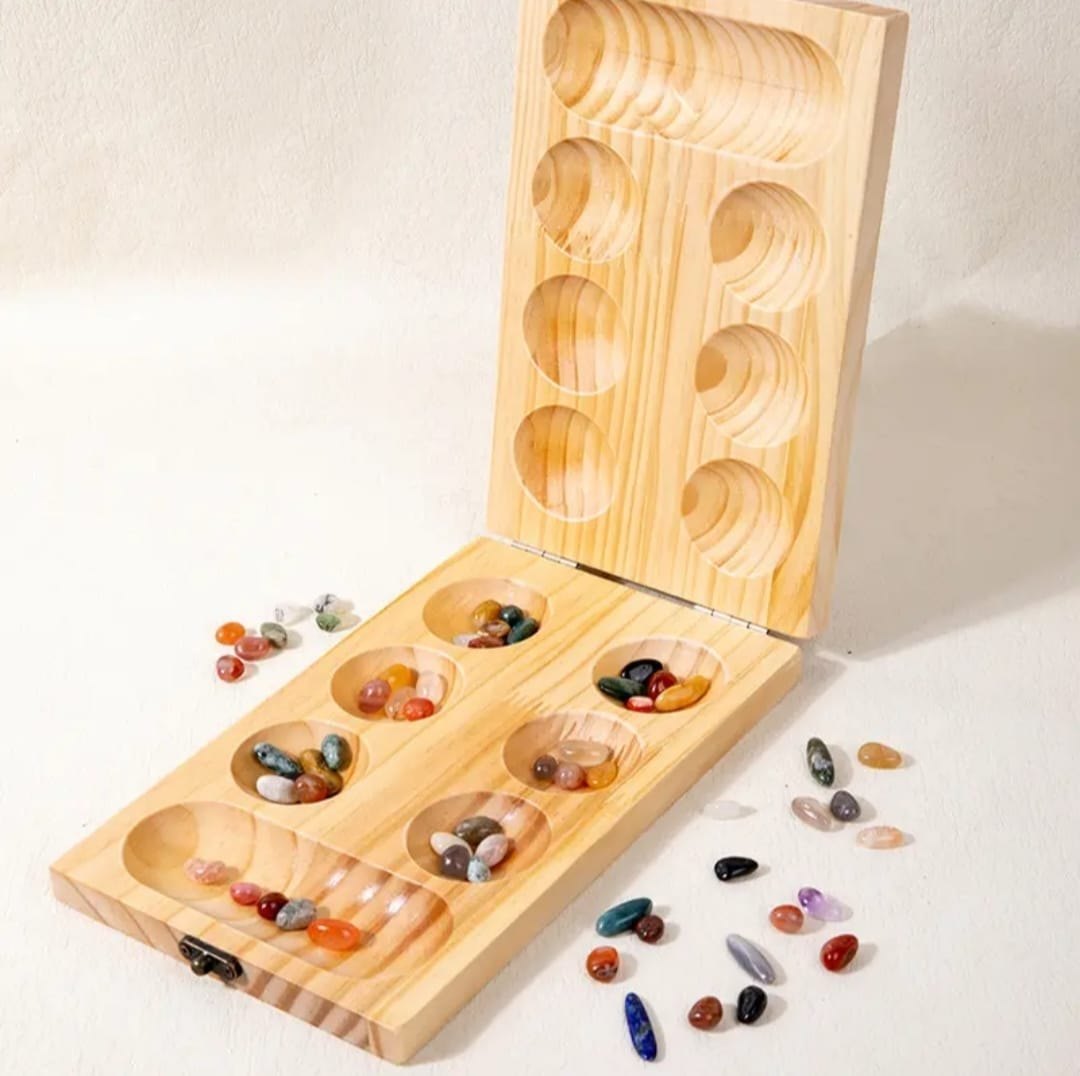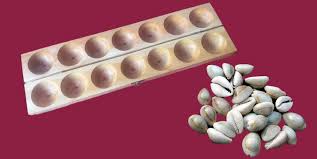





Pallanguli — a South Indian game for two players. The objective is to capture more seeds, shells, or pebbles than your opponent. Rules vary by region and family; the sections below summarise common setups and ideas. The in-browser game in the next section uses a simplified ruleset for quick play online.
Play online
Players & audience
Spectators can open an audience window on this device (same browser as the players) using Open audience view in the View control below the board.
Remote viewers (another room or online) are not connected to this page automatically — use screen sharing, a video call, or stream the match so they can see your screen.
Constitution — rules of this table
The in-browser game is implemented to follow this constitution only. South row = Player 1 (cups 0–6); north row = Player 2 (cups 7–13).
- Two accounts. There are exactly two: Player 1’s and Player 2’s. Each account is the sum of shells in cups on that player’s row, shells in that player’s drawer (gains from triples), and shells held as refill left after a round’s distribution (not yet placed in cups). Every gain belongs to one of these two accounts. With the usual start (5 per cup), the two accounts total 70 shells — none vanish. Separately, reserve means how much that player’s full account exceeds 35 (half of 70); if the account is 35 or less, reserve is 0.
- Who opens. A new match begins on Player 1’s turn. After each round, the winner of that round opens the next.
- Sowing. On your turn you choose a non-empty cup on your row. You lift all shells there and drop one per cup moving counter-clockwise around the board (skipping your source cup until the lap would reach it again).
- End of your turn. If your last shell of the current sow lands in an empty cup (that cup then shows 1), your turn ends. There is no opposite-cup capture.
- Relay. If your last shell lands in a cup that already had shells, pick up all shells in that cup and continue sowing from the next cup in order. Repeat until rule 4 applies or rule 6 applies.
- Exactly three in one cup. As soon as a cup holds exactly three shells after a drop, those three are removed immediately into one player’s drawer (that player’s account increases by 3); the cup is then empty. This rule does not apply to a marked lucky pit: shells that enter the lucky pit during sowing bank straight to that row owner’s drawer (see below), so a triple never sits there. Who receives a normal triple: If that drop was your last shell of that sow and the cup had exactly two shells before the drop, you receive the three — whether that cup is on your row or the opponent’s row. The same moving player also receives the three if their last shell of that sow completes a triple in a cup on the opponent’s row (same outcome as 2→3 in one step). In all other cases, the player who owns that row receives the three.
- Round end. When one side has no shells in its row, the other player’s remaining shells on the board are gathered into that player’s side for the next distribution (refill left rules below).
- Refill and refill left. Between rounds, each player’s stock refills up to 5 shells per cup on their row; any leftover shells for that player stay off the board as refill left until the next distribution. The drawer is not spent to refill cups. If refill leaves exactly one shell in refill left, that player may sow that one shell on their turn when the control allows; otherwise it stays locked until the next round’s distribution.
- Lucky pit. When a player’s reserve (account over 35) equals one more than any of 0, 5, 10, 15, 20, 25, 30, 35, 40, 45, 50, 55, 60 — i.e. 1, 6, 11, 16, 21, 26, 31, 36, 41, 46, 51, 56, or 61 — that player may mark one cup on their row as their lucky pit. Next-round refill when that player has a marked lucky pit and at least 31 shells to place: put 5 in each of the other six cups, 1 in the lucky pit (the marking shell), and the remainder in refill left — e.g. 61 shells → 30 on the row in those six cups, 1 in the lucky pit, 30 in refill left. A player with fewer shells uses the usual refill (up to 5 per cup in order), e.g. 9 → one cup with 5 and 4 in refill left. During play, whenever sowing drops into the lucky pit, every shell then in that cup (from either player’s moves) is immediately added to the lucky pit owner’s drawer; the cup is then empty for further drops.
- Match end. When no shells remain in play on the board, the player with the larger full account wins the match.
Simplified rules
The Constitution (above) is the only binding ruleset for this page. In short: two accounts (cups on your row + drawer + refill left), reserve = account over 35, 70 shells total, sow counter-clockwise, relay when your last shell lands in a non-empty cup, your turn ends when your last shell lands in an empty cup, triples go to the row owner except when your last shell makes 2→3 (then you get them on any row); a marked lucky pit banks incoming shells to its row owner instead. Use Player 1 / Player 2 view to turn the board; drawers show part of each account and the header shows full counts.
How to play (this version)
Same rules as the Constitution. The list below is only UI and layout.
- View: Player 1 — Player 1’s row and drawer are nearest you (down). Player 2 — pink/red pits nearest (down), blue on the far side. Shells still sow counter-clockwise.
- Who opens: A new match starts with Player 1’s turn. After each round, the winner of that round opens the next round (whether they are Player 1 or Player 2).
- Each pit starts with 5 shells (70 total).
- Header line: Shows round, whose turn, and each account as n/35 (35 shells per side in a full 70-shell match).
- Drawer captions: Account total with breakdown (cups · drawer · refill left · reserve over 35).
- Refill-left sow: When refill leaves exactly one shell in refill left, the highlighted control sows it from your row’s start cup, then the same relay / end rules as the Constitution.
- Lucky cup: When your reserve is one more than 0, 5, 10, …, 60 (i.e. 1, 6, 11, …, 61 in steps of 5), use Mark lucky cup on your turn. With a marked lucky pit and 31+ shells to refill, you get six cups at 5, the lucky cup at 1, rest in refill left (61 → 30 refill left). Shells that enter the lucky pit in play go straight to that row owner’s drawer.
Watch how it’s played
External video on YouTube — use it alongside the written rules. The simplified online practice game in the “Play online” section is not a frame-by-frame copy of this clip. Open on YouTube
Traditional game — reference rules
1. Game setup
- Board: A rectangular board with 14 pits in two parallel rows (7 per row).
- Counters: Traditionally 70–146 counters total (seeds, shells, cowries, or small stones), depending on variant and round.
- Initial fill: Place the same number in each pit. 5 or 6 per pit are the most common starting counts in many areas; some tables use different totals.
2. Basic gameplay
- Start: The first player lifts all counters from any non-empty pit on their own side.
- Distribution (sowing): Moving counter-clockwise, they drop one counter into each successive pit, including pits on the opponent’s side.
- Continuing a move: In full rules, if your last counter lands in a pit that already contains counters, you usually pick up all counters in that pit and continue sowing from the next pit — repeating until your last counter lands in an empty pit (then special capture rules may apply, or your turn ends).
- Simple end of turn: In some teaching versions, if your last counter lands in an empty pit, your turn ends without continuation.
3. Capturing rules (variants)
- “Empty pit” / next-pit capture: In one style, if your last counter falls into an empty pit and the pit immediately following in the sowing direction contains counters, you may capture those counters (wording varies by source).
- Opposite-pit capture: In other variants, if your last counter lands in an empty pit on your side, you capture the counters in the pit directly opposite on the opponent’s row.
- “Pasu” (four) rule: In some rulesets, if a pit you touch ends with exactly four counters, you capture those four immediately.
4. Winning and later rounds
- End of a round: Often when one entire side of the board has no counters left in its pits.
- Refilling: Players take their captured stock and refill their seven pits back to the agreed start count (e.g. 5 each) for the next round.
- Thokkam (“rubbish holes”): If a player cannot fill every pit, unfilled pits may be treated as disabled for the next round.
- Match victory: Play can continue across several rounds until one player can no longer place even a single counter to start a round — that player loses the match.
The interactive board above implements continuation sowing (relay), multi-round refill (5 per pit, savings when stock allows), and a savings sow when refill leaves exactly one shell — but not Pasu or Thokkam — see “Play online” for the exact playable rules.
Reference photos
Reference photos of wooden boards, then the simplified online board (same 2×7 layout).